Aschenbach’s creative crisis
Death in VeniceAschenbach’s creative crisis is the conflict between reliable artistic craftsmanship and his increasingly frustrated demand for work that feels emotionally alive. It first drives him to seek a change of scene; at the Lido, beauty and idleness briefly revive his capacity to write, even as his attention to Tadzio makes creative renewal inseparable from personal surrender. The crisis is therefore not simply an inability to work: it exposes the costs of the discipline that made Aschenbach’s achievement possible, and the unstable ways in which desire can restore or overwhelm artistic form.
Discipline and the Impasse
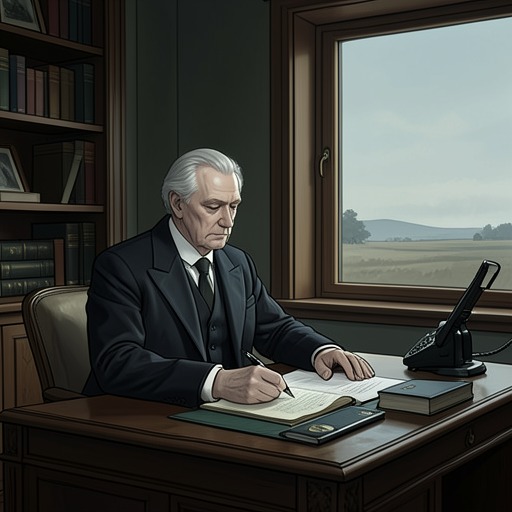
Aschenbach’s block emerges against a life organized around deliberate effort. He has trained himself to restrain emotion because he believes that feeling settles too readily for approximation and partial completion. For him, talent requires an exacting dissatisfaction with what is almost finished. That standard has helped shape his work, but now turns against him: the passage he has left unfinished resists both patient coaxing and a direct assault, and he experiences his own fastidiousness as an obstacle rather than a guarantee of quality.
The difficulty is not that his writing has become incompetent. Aschenbach retains an assured command of his craft, and the nation honors him for it. What he cannot find in his work is the fiery, fluctuating emotionalism that would make it feel fully alive to him. He suspects that the emotions he has long subjected to discipline are now withholding their assistance, draining interest from both form and expression. The contrast between public recognition and private dissatisfaction gives the crisis its particular force: the established artist can still produce, but no longer believes that technical command alone amounts to artistic vitality.
His weariness has accumulated beneath a proud, tenacious will that he has tried not to let show in his productions. He loves his work, and even the exhausting struggle of sustaining it, yet recognizes a pressure to escape the steady service to which he has committed himself. A summer alone at his mountain house, with its familiar view of peaks and slopes, threatens to magnify his boredom and discontent rather than restore him. Travel becomes a practical break from the impasse, but also an admission that sheer obstinacy may have tightened the bow too far.
Travel and the Unexpected Return
Aschenbach’s choice is measured rather than open-ended: he plans a short journey, one night on a sleeper train and three or four weeks at a southern resort, not a prolonged wandering. The trip is meant to bring a change of air and freshness, making the summer both bearable and potentially productive. In that sense, his movement away from his customary routine begins as an attempted remedy for the conditions under which the crisis has developed.
His return to the Lido after his trunk is misdirected turns that planned departure into an unintended reversal. Once he learns the trunk cannot be stopped, Aschenbach says he will not travel without it and arranges to go back to the beach hotel. Twenty minutes after reaching the station, he is again crossing the Grand Canal toward the Lido. What had seemed a departure is converted into a return, and he greets the reversal with concealed delight beneath a show of irritation. The episode supplies no direct solution to his unfinished work; instead, it restores him to the place where his attention will be absorbed by a new and increasingly powerful stimulus.
Idleness, Beauty, and Renewed Writing
The settled rhythm of the Lido relaxes the will that had previously pulled Aschenbach back from holidays to rigorous work. Mornings by the sea and journeys to Venice replace his customary routine. His experience of leisure is not merely an interval away from writing: the regular days and the proximity of the city make the resort feel like an alternative order of life, one in which he can stop measuring himself against work.
Tadzio becomes a recurring presence within this routine. Aschenbach sees him in the hotel, on the journeys to the city and back, in the arcades of the square, and especially on the beach, where the regularity of their days gives him repeated opportunities to watch the boy. He rises early as he once did under the pressure of work, takes his place beneath the brown canopy, and spends the long morning looking on while Tadzio moves between play and rest on the sand. The repetition matters: what begins as looking becomes a daily expectation that helps make the stay precious to Aschenbach.
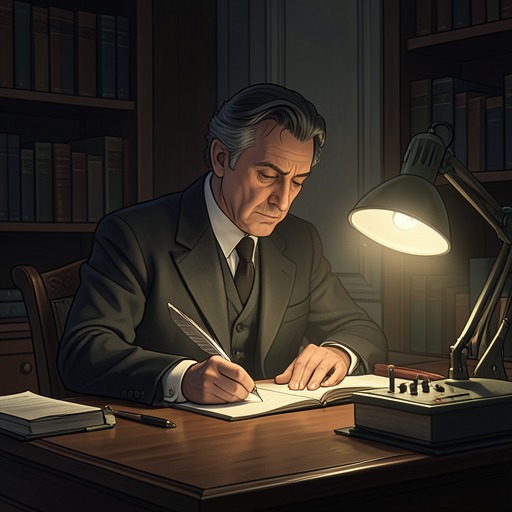
That attention unexpectedly unlocks a new act of composition. An intellectual request for a statement on a major issue of culture and taste reaches Aschenbach, whose experience makes the subject feel available to him. He imagines beauty as the point at which feeling can become thought and thought can become feeling, and wants to write in Tadzio’s presence. The boy’s form becomes a standard for the style of the work, allowing Aschenbach to carry an impression of physical beauty into spiritual expression. He produces a page and a half of polished prose whose clarity and emotional force win admiration.
The accomplishment does not resolve the crisis cleanly. The writing is pleasurable precisely because it comes from a source whose circumstances might, if known, unsettle the reception of the finished work. Aschenbach experiences this creative encounter as at once fruitful and enervating; after putting away the writing, he feels exhausted and dispersed, as though conscience were registering a transgression. The episode thus brings his problem into sharper focus: the emotional intensity he had feared losing returns, but in a form that makes artistic inspiration difficult to separate from the desire that supplies it.
From Creative Stimulus to Surrender
The renewed artistic energy accompanies a broader abandonment of restraint. Aschenbach ceases to count down the days of his vacation and no longer thinks of going home. He sends for more money and worries instead that the Polish family may leave. Sleep grows fitful, and he wakes before dawn to watch the sunrise; the returning emotions and yearnings of his earlier life arrive in unfamiliar forms. The scene presents his inward change through a reversal of habit: the man whose days were once governed by work now organizes them around the possibility of seeing Tadzio.
His attempt to speak to the boy shows how little the return of feeling has restored his composure. When he catches up with Tadzio on the boardwalk, he means to offer a friendly greeting, but his heart pounds, he loses his breath, and he cannot bring himself to speak. Afraid of being observed and appearing ridiculous, he gives up and passes with his head bowed. He can mock his own defeat, but the incident makes the imbalance plain: his attention has become intense while his ability to act with ordinary ease has diminished.
That imbalance deepens into furtive pursuit through Venice. Aschenbach follows Tadzio and his companions, hiding when they stop and searching for them when he loses sight of them. When they take a gondola, he hires another and instructs its rower to follow at a distance. The movement from watching at the beach to secret tracking marks a change in the role of desire: it no longer merely supplies an image for artistic work but directs Aschenbach’s conduct. The narrator characterizes him as intoxicated and as following an impulse that overrides reason and dignity, linking this episode to the earlier account of emotion returning as a creative stimulus while showing how far that stimulus has carried him.
Resolution of the Crisis
The crisis ends not in a recovered balance between discipline and feeling, but in Aschenbach’s death. In the final scene he watches Tadzio at the water’s edge, separated from the boy and from the people around him. When Tadzio looks back, Aschenbach imagines a smile and a gesture inviting him onward, then rises as if to follow. The interpretation belongs to Aschenbach’s perception; the scene does not establish that Tadzio has actually offered such an invitation.
Aschenbach collapses in his chair. Some minutes pass before anyone hurries to help him; he is taken to his room, and news of his death is received that day by a shocked world. The abrupt ending closes the trajectory that began with an unfinished passage and the search for fresh air. Artistic discipline once held weariness and emotion in check; the return of feeling briefly makes new work possible, but its growing force ultimately displaces the purpose and self-command that had structured his life. The crisis’s significance lies in that unresolved exchange: inspiration returns, yet it does not restore the artist who sought it.